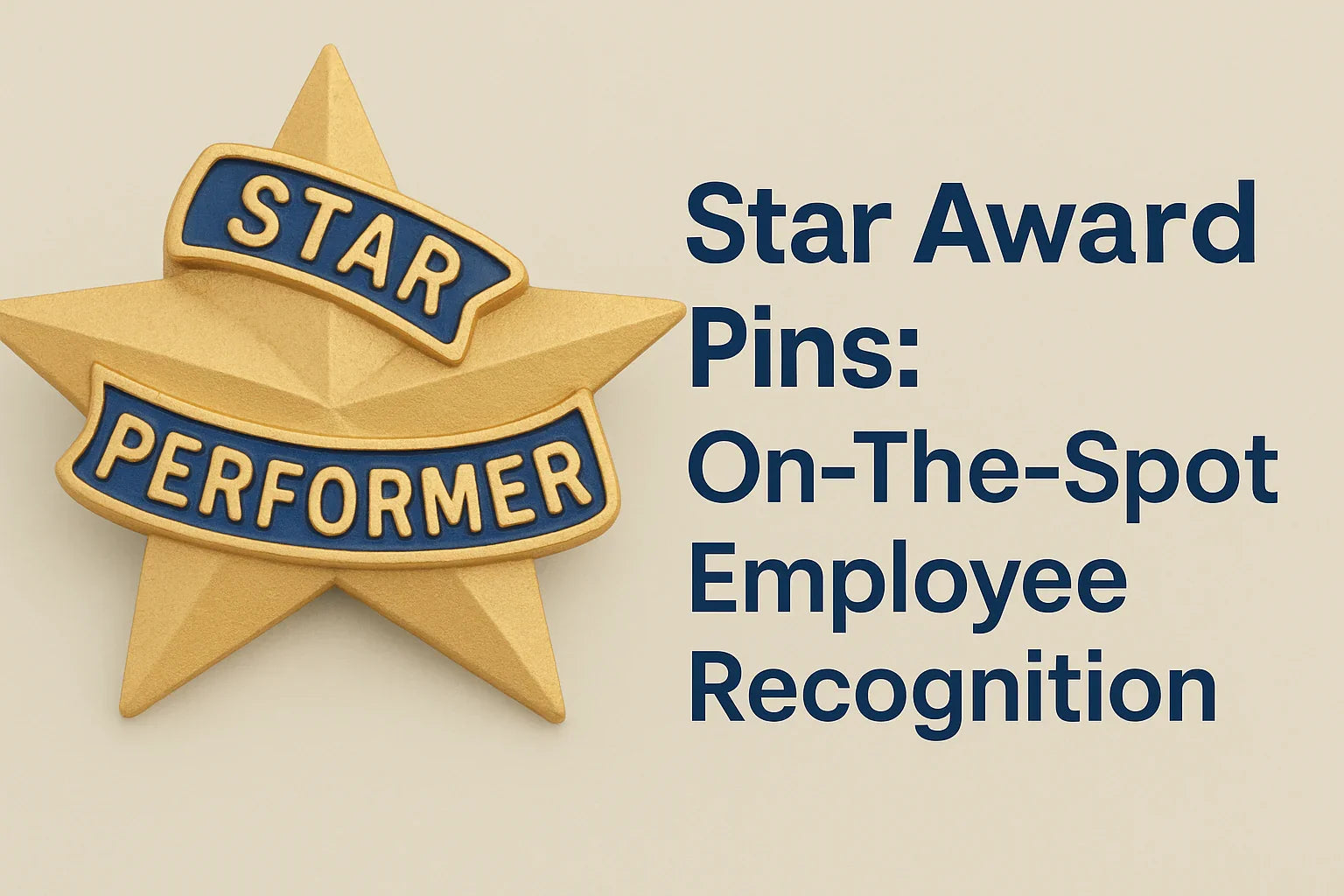
How to Use Star Award Pins for On-the-Spot Employee Recognition
A great employee moment can disappear quickly.
Someone calms an upset customer. A team member stays late to help finish an urgent order. An employee notices a safety problem before anyone gets hurt.
Managers often appreciate those actions. The problem is that they do not always recognize them while the moment is still fresh.
Star award pins give managers a simple way to do that.
The pin may be small, but the message behind it can carry real weight when it is presented promptly, tied to a specific action, and accompanied by a sincere explanation.
Hand someone a pin without saying much, and it may feel like a giveaway.
Tell them exactly what they did, why it mattered, and who it helped? Now the pin becomes a reminder that someone noticed.
What Is On-the-Spot Employee Recognition?
On-the-spot employee recognition is praise or acknowledgment given soon after an employee does something valuable.
It might recognize exceptional customer service, teamwork, leadership, safety awareness, problem-solving, or extra effort during a difficult shift.
Timing matters.
Recognition given a few minutes or hours after an accomplishment usually feels more connected and genuine than praise delivered several weeks later during a meeting or performance review.
Star award pins work well for immediate recognition because managers can keep them nearby and present them without paperwork, software, or a lengthy approval process.
Employees can wear the pins on a uniform, jacket, lanyard, badge holder, or hat. They can also save them as part of a personal collection.
Why Use a Physical Star Pin?
Verbal praise is important, but it can pass quickly.
An email may be appreciated, but it soon gets buried under dozens of other messages.
A physical pin gives the recognition a lasting form.
Star award pins can be:
- Easy for managers to present
- Visible and tangible
- Affordable enough for ongoing use
- Appropriate across departments and job roles
- Connected to company values
- Simple to manage without a complicated system
Star pins do not need to replace formal recognition programs.
They can work alongside years-of-service awards, employee-of-the-month programs, safety awards, plaques, engraved awards, and other major recognition. Their purpose is different.
They acknowledge the smaller moments that happen between major milestones.
What Should a Star Award Pin Recognize?
A star pin program works best when employees and managers understand what the award represents.
Without clear examples, recognition can feel inconsistent. One manager may give pins frequently while another rarely gives them at all. Employees may also wonder why one action earned recognition while another did not.
Clear criteria help prevent that confusion.
Star award pins may recognize employees for:
- Providing exceptional customer service
- Helping a coworker complete an urgent task
- Showing leadership during a difficult situation
- Preventing a safety incident
- Receiving positive customer feedback
- Training or supporting a new employee
- Solving a difficult problem
- Improving a process
- Supporting another department
- Staying calm under pressure
- Demonstrating a company value
- Going beyond normal job expectations
The goal is not to reward every routine task.
It is to notice meaningful actions that deserve more than a passing “good job.”
How to Build a Simple Star Pin Recognition Program
During the 12 years I operated a service business, I led a team of about 15 employees. Several stayed with the company for 7 to 12 years.
That did not happen because of one award program.
People stay for many reasons. They want fair treatment, clear expectations, steady leadership, and a workplace where their contributions matter. Recognition supports that culture, but it cannot replace it.
A star pin program should reinforce good management, not attempt to cover for poor management.
Fortunately, the program itself does not need to be complicated.
A practical approach can follow six steps:
- Define the behaviors managers should recognize.
- Choose one pin or a small group of clearly defined designs.
- Give each supervisor a supply of pins to keep nearby.
- Present the pin as soon as practical after the action.
- Explain what the employee did and why it mattered.
- Track recognition to help maintain fairness across departments and shifts.
The fifth step matters most.
A manager could simply say:
“Good job today.”
That is better than saying nothing, but it is vague.
A stronger version would be:
“Thank you for staying late to help the new employee finish that order correctly. You helped us stay on schedule and made a stressful situation easier for the entire team.”
That explanation connects the award to a real contribution.
It also shows the employee which behaviors the company values.
Make Sure Managers Have Pins Available
Many spot-recognition programs fail for a surprisingly simple reason.
The manager does not have an award available when the moment happens.
The employee does something exceptional. The supervisor plans to recognize it later. Then the shift gets busy, another issue comes up, and the moment passes.
Keeping a small supply of pins with each supervisor removes that obstacle.
Recognition becomes easier when the tool is already there.
How Managers Should Present Star Award Pins
The presentation does not need to become a ceremony.
It should, however, feel intentional.
Managers should:
- Present the pin close to the time of the accomplishment
- Name the exact behavior being recognized
- Explain why the action mattered
- Keep the praise honest and specific
- Consider whether the employee prefers public or private recognition
- Avoid exaggerated compliments that may feel forced
Some employees enjoy being recognized in front of the team.
Others would rather receive a quiet thank-you away from the group.
Both approaches can work.
The manager should recognize the behavior in a way that feels meaningful to the employee, not simply convenient for the manager.
A useful rule is to praise the action, not just the person.
“You’re amazing” may sound encouraging, but it does not tell the employee what they did well.
Specific praise feels more credible.
Preventing Favoritism
Spot recognition can create resentment when the same employees receive every award or when certain shifts and departments are repeatedly overlooked.
Fair does not mean every employee must receive the same number of pins.
It means the criteria are clear and the opportunity for recognition is consistent.
Organizations can reduce favoritism by:
- Publishing examples of qualifying behaviors
- Training managers on when to give a pin
- Recognizing contribution rather than personality
- Tracking who receives recognition
- Reviewing awards by department, location, and shift
- Including remote workers, part-time employees, support staff, and night-shift teams
- Allowing both individual and team recognition
Tracking does not need to become burdensome.
A basic spreadsheet or simple recognition log may be enough.
The goal is to spot patterns. Is one manager giving nearly every pin? Is an entire department being missed? Are only the most outgoing employees being noticed?
Those questions are worth asking.
Avoiding Recognition Fatigue
Can an organization recognize employees too often?
Yes.
If every routine task earns the same award, the pin may lose its meaning. Employees can tell when recognition is sincere and when management is simply handing out prizes.
Star pins should be easy to give, but not meaningless.
The award should still reflect an action, contribution, or behavior that deserves attention.
Recognition works best when it feels earned.
Choosing Star Pin Designs and Award Levels
Some organizations use one universal star pin for every spot-recognition moment.
This keeps the program simple. Managers do not need to decide between several award categories, and employees quickly learn what the pin represents.
Other organizations prefer multiple designs or levels, such as:
- Gold star pins for exceptional achievement
- Silver star pins for strong performance
- Bronze star pins for everyday excellence
- Teamwork pins
- Leadership pins
- Safety pins
- Customer service pins
- Star performer pins for monthly or quarterly recognition
Either approach can work.
A tiered program creates more structure, but it also creates more room for confusion.
What separates gold from silver? Is bronze still a meaningful award, or does it feel like third place? Will managers apply the criteria consistently?
Those questions should be answered before launching the program.
For many organizations, one pin or a small group of clearly defined designs is the best place to start.
More levels can always be added later.
How Many Star Pins Should Managers Keep Available?
There is no perfect quantity for every organization.
A supervisor managing a small team may need only a modest supply. A larger company may need pins distributed across several locations, departments, or shifts.
Availability matters more than the starting number.
A practical approach is to give managers an initial supply and review usage after a few months.
If very few pins are being presented, the organization may need:
- Clearer award criteria
- Better manager training
- More frequent reminders
- Stronger leadership support
If the supply disappears almost immediately, the criteria may be too broad.
Either result provides useful information.
Should Recognition Be Public or Private?
Public recognition can reinforce positive behavior across a team.
It may work well when an employee reaches a visible milestone, helps the entire department, or demonstrates an important company value.
Private recognition may be better when:
- The employee dislikes public attention
- The situation is personal or sensitive
- The manager wants the conversation to feel more genuine
- Public praise could embarrass the recipient
The pin gives employees some control afterward.
They can wear it, display it, save it, or keep the recognition private.
Star Award Pin Program Checklist
Before starting a program, decide:
- Which behaviors should earn a pin?
- Who can present the awards?
- Will the program use one design or several levels?
- Should recognition be public, private, or determined case by case?
- How should managers explain each award?
- How many pins should supervisors keep available?
- Will recognition be tracked?
- How often will the program be reviewed?
- Can an employee earn the same pin more than once?
- Should the pin include a card, certificate, or handwritten note?
A short recognition card can be especially useful.
The manager can write down what the employee did, while the pin gives the employee something visible to keep.
How Star Pins Fit Into a Larger Recognition Program
Star award pins are one part of a broader recognition strategy.
Years-of-service awards honor long-term commitment. Plaques and engraved awards often mark major accomplishments. Safety awards may recognize months or years without an incident.
Star pins fill a different role.
They recognize the smaller moments that could easily pass without acknowledgment.
Those moments matter.
They show employees that leadership is paying attention not only to final results, but also to the everyday actions that help customers, strengthen teams, and keep the organization moving.
Shop Star Award Pins
AwardsHere.com offers star award pins for employee achievement, spot recognition, safety, teamwork, leadership, customer service, and star performer programs.
Use one consistent pin for a straightforward program, or combine several designs for different recognition categories.
Qualifying pins and awards automatically combine for quantity discounts at checkout, making it easier to order for multiple departments, locations, or programs.
Browse our Star Award Pins collection, or contact AwardsHere.com for help choosing one universal pin or building a simple multi-level recognition program.
Reviewed by Brandon Jared, AwardsHere.com
Brandon Jared has more than 25 years of graphic design experience and works directly with employee recognition products, custom awards, production artwork, and supplier proof review.
He also owned and operated a service business for 12 years, where he led a team of approximately 15 employees. Several team members remained with the company for 7 to 12 years, giving him first-hand experience with employee retention, workplace recognition, and building a team people wanted to remain part of.