
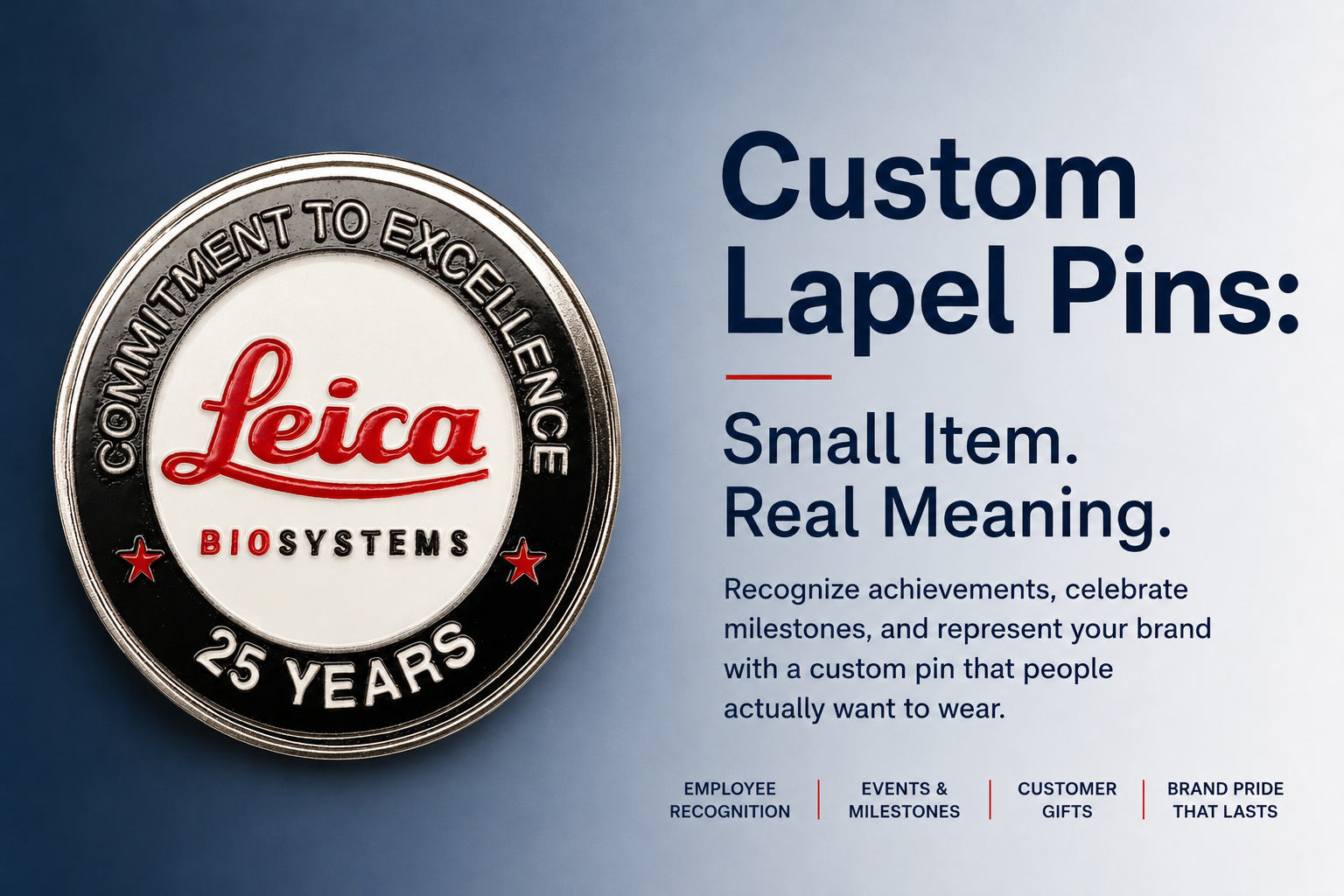
Custom Lapel Pins People Want to Keep: Design and Production Guide
Custom lapel pins are easy to underestimate.
They are small. They are simple. They do not take up much space on a desk, in a drawer, or in a box of event supplies.
But that is part of why they work.
A good custom pin is not trying to be a flyer, brochure, or billboard. It is a small symbol people can wear, keep, collect, or give to someone as a sign that something mattered.
That might be an employee achievement. A company anniversary. A safety milestone. A trade show. A customer loyalty program. A fundraiser. A team event. A new product launch. The reason changes, but the idea is usually the same: the pin represents something specific.
AwardsHere.com has helped organizations with recognition and award products since 1988, and custom lapel pins continue to fit many different situations without feeling oversized or overdone.
The key is giving the pin a clear purpose.
A Custom Pin Should Represent Something Specific
A custom pin that only says “here is our logo” may still look nice, but it probably will not mean much.
A pin that says “you earned this,” “you were part of this,” “you helped make this happen,” or “this moment matters” has a better chance of being kept.
That is why custom lapel pins work well for recognition programs, milestone events, team identity, and special campaigns. They give people something physical to connect with a specific memory or accomplishment.
A years of service pin represents time and loyalty. A safety pin can represent a shared commitment to doing the job the right way. A medical certification pin can represent training, skill, and professional pride. A volunteer pin can represent hours of service that might otherwise go unnoticed.
The value of the pin is not only in the material. It is in what the pin stands for.
Why Small Recognition Items Can Have Staying Power
Many promotional products are useful for a short time and then disappear. Flyers get thrown away. Event bags get emptied. Larger gifts may be appreciated, but they are not always easy to wear, display, or keep nearby.
A lapel pin is different because it is small enough to stay with someone.
It can be worn on a jacket, badge holder, uniform, lanyard, hat, backpack, or display board. It can be collected over time or become part of a recognition program where each pin marks another milestone or accomplishment.
That makes pins especially useful for organizations that want recognition to be visible without being expensive or complicated.
Common Uses for Custom Lapel Pins
Custom lapel pins can be used in many different ways, but they are strongest when the reason for the pin is clear.
Organizations often use custom pins for:
-
Employee recognition
-
Years of service programs
-
Safety milestones
-
Safe driver recognition
-
Medical and nursing certifications
-
Volunteer appreciation
-
Company anniversaries
-
Fundraising campaigns
-
Trade shows and conferences
-
Product launches
-
School and academic recognition
-
Team identity
-
Customer appreciation
-
Membership programs
-
Retirement recognition
The design does not have to explain everything. In fact, the best pins usually do not. A clear symbol, short wording, strong color choice, and the right shape can do more than trying to fit a full message onto a small piece of metal.
Custom Lapel Pin Design Guidelines Most Buyers Do Not Know
A custom lapel pin is a small product, so small design choices matter. Artwork that looks clear on a computer screen may not work the same way when reduced to actual pin size.
Real-World Size Limitations
¾-Inch Pins: Best treated as a simple mark, number, initials, or one short word.
1-Inch Pins: Can often handle a logo with limited wording, such as a short department name, year, or award title.
1¼-Inch Pins: Offer more room for borders, dates, years of service, and secondary text, but still should not be treated like a business card.
For small pins, fewer words almost always produce a better result. Bold, simple lettering is usually easier to reproduce at small sizes than thin or highly stylized type. All-uppercase lettering can work especially well for short wording and curved borders, provided the letters are spaced clearly.
Taglines, long company names, small registration marks, and detailed secondary text may need to be removed, enlarged, or printed instead of enamel-filled.
Enamel vs. Print Production Limits
Enamel production has physical limits. As a general working guideline, traditional enamel designs often require metal separator lines of approximately 0.3–0.4 mm, although exact requirements vary by manufacturer, base metal, plating, pin size, and production method.
Text size is another common issue. Point size alone does not determine whether lettering will reproduce clearly because fonts vary in their visible letter height, weight, spacing, and shape. When artwork is prepared at final pin size, 8-point type can be used as an initial minimum, but important lettering is generally safer when the visible capital letters are approximately 3 mm tall or larger.
Simple, medium- or bold-weight sans-serif fonts are usually easier to reproduce at small sizes than thin, condensed, script, serif, or highly stylized lettering. Final readability should always be evaluated with the artwork displayed at the pin’s actual finished size.
Small text, gradients, detailed logos, shadows, photographs, tiny windows, facial features, and multicolor artwork with very small separations are often better handled with full-color UV printing. Enamel is best when the design can be divided into clear, separated color areas.
In one recent artwork review, a customer wanted a one-inch recognition pin containing a detailed logo, award title, anniversary date, and curved tagline. At actual size, the tagline and several logo details could not be reproduced clearly in enamel. We enlarged the award wording, removed the tagline, and recommended printing the smallest logo details. The revised design remained readable without changing the purpose of the pin.
Preparing Artwork for Production
Fonts should be converted to outlines in final artwork so the lettering does not change when files are opened for production.
Pantone color references are helpful for enamel projects because they give the factory a defined color target rather than relying on RGB or CMYK screen colors alone. Finished enamel colors may still vary slightly because of material, plating, production batch, and viewing conditions.
Plating choice can also change perceived contrast. Black nickel, antique finishes, gold plating, silver plating, and polished metal can each make the same enamel colors feel different once the pin is produced.
Shape, Attachments, and Wearability
Shape matters. Round, oval, square, and balanced shapes usually sit more predictably when worn. Tall, horizontal, heavy, or asymmetrical pins are more likely to rotate and may need two posts instead of one.
Highly pointed outside shapes can also be harder to handle, package, or wear comfortably, especially on daily-use pins.
Attachment choice should match how the pin will be used.
A butterfly clutch is common and economical for general use. A deluxe clutch can feel more secure and professional for recognition pins. Rubber clutches are softer against the body and may be more comfortable for some daily wear situations.
Magnetic attachments can help avoid holes in delicate clothing, although they are not ideal for every fabric or work environment.
Reorders and Long-Term Programs
Reorder planning is important for recognition programs. Customers should keep the approved artwork, pin size, plating, enamel colors or Pantone references, production method, attachment choice, and any mold or tooling details.
Existing tooling can often be reused when the pin’s size, outside shape, and raised and recessed metal areas remain unchanged. Changes to any of those elements may require a new mold.
Choosing the Right Custom Pin Style
There is no single best type of custom lapel pin. The right choice depends on the artwork, timeline, budget, quantity, and how the pin will be used.
Hard Enamel Pins
Hard enamel pins have a smooth, polished finish. They are often a good fit when the pin needs to feel more formal, durable, or jewelry-like.
They work best with clean artwork, clear color separations, and designs that do not rely on extremely small detail.
Soft Enamel Pins
Soft enamel pins have recessed color areas, which gives the design more texture and depth.
They are a popular choice for custom logo pins, event pins, award pins, and collectible designs when a traditional pin appearance with visible metal detail is desired.
Die-Struck Pins
Die-struck pins use raised and recessed metal without enamel color.
They can be a good choice for elegant, classic, or professional designs where the shape, metal finish, and engraving-style detail matter more than color.
Full-Color Printed Pins
Full-color printed pins are often better when the artwork includes gradients, small lettering, detailed logos, photographs, or artwork that cannot easily be divided into enamel-filled sections.
Printed pins can also be a practical option when the design needs more visual detail than traditional enamel production can hold.
The best custom pin is not always the most expensive option. It is the option that fits the design, deadline, and purpose of the pin.
Fast Laser-Engraved Custom Pins for Recognition Projects
Laser engraved acrylic insert pins can be an attractive option when you need a clean, professional custom pin without the longer timeline of traditional enamel production. Instead of using enamel-filled color areas, the design is laser engraved onto an acrylic insert, creating a crisp contrasting look that works well for logos, text, service milestones, employee recognition, and simple award designs.
This option is especially useful for time-sensitive recognition projects, last-minute events, small programs, or customers who want a custom pin without waiting several weeks for traditional tooling and enamel production. Laser engraved acrylic insert pins are manufactured and shipped within 1–2 business days after artwork approval, making them one of the fastest custom pin options available from AwardsHere.com.
Because laser engraved acrylic insert pins rely on contrast, clean lettering, and clear artwork, simple designs usually work best. They are a strong choice when the goal is a polished custom pin with quick production, clear branding, and a professional presentation.
How to Keep a Custom Pin Design Strong
Because lapel pins are small, simple usually wins.
A strong custom pin design should be clear from a normal viewing distance. If someone has to hold the pin close to understand it, the design may be trying to do too much.
Before placing an order, it helps to ask:
-
What is the main message of the pin?
-
Does the design still work when reduced to actual pin size?
-
Is the text short enough to read?
-
Are the colors simple and separated clearly?
-
Does the shape help the design or make it harder to wear?
-
Will this pin need to be reordered later?
-
Is this a one-time event pin or part of an ongoing program?
-
Should small details be printed instead of enamel-filled?
-
Does the pin need one post or two?
-
Which attachment makes the most sense for how the pin will be worn?
These questions can prevent many common artwork issues.
The most common custom pin revisions usually happen because the original artwork has too much detail, text that is too small, lines that are too thin, colors that are not separated clearly, or design elements that do not translate well to the production method being used.
That does not mean the design has to be boring. It means the artwork needs to be built for the final size and production process.
Custom Pins for Recognition Programs
Custom lapel pins are especially useful for programs that repeat over time.
A company might use them for annual service awards. A hospital might use them for certification recognition. A nonprofit might use them for volunteer hours. A transportation company might use them for safe driving milestones. A school might use them for student achievement or leadership recognition.
When a program will continue year after year, consistency matters. The pin design should be simple enough to reorder, flexible enough to support future milestones, and distinctive enough that people recognize what it represents.
Approved artwork, size, finish, colors, attachment style, and production method should be preserved so future orders match the original program as closely as possible.
When a Custom Pin Becomes More Than a Logo
A custom lapel pin works best when it connects to a larger moment.
For employees, that might be a service milestone, safety achievement, certification, or performance award. For volunteers, it might mark a certain number of hours served. For schools, it might represent a club, academic award, graduation program, or leadership role. For businesses, it might recognize a company anniversary, customer appreciation event, or internal campaign.
The pin becomes meaningful because it is tied to a person, place, team, or shared accomplishment.
A pin handed out with no explanation may be forgotten. A pin presented as part of a recognition moment is more likely to be kept.
Small Pins Can Still Carry Real Value
A custom lapel pin does not have to be large, complicated, or expensive to matter.
It just needs to represent something worth remembering.
That might be a year of service, a job done safely, a certification earned, a volunteer shift completed, a company milestone reached, or a team effort recognized.
When the purpose is clear and the design is built for the size and production method, a custom pin can become a symbol of belonging, achievement, appreciation, and shared identity.
That is what gives a custom lapel pin real meaning.
Reviewed by Brandon Jared, AwardsHere.com
Brandon has more than 25 years of graphic-design experience and works directly with custom recognition products, production artwork, UV printing, and supplier proof review.